




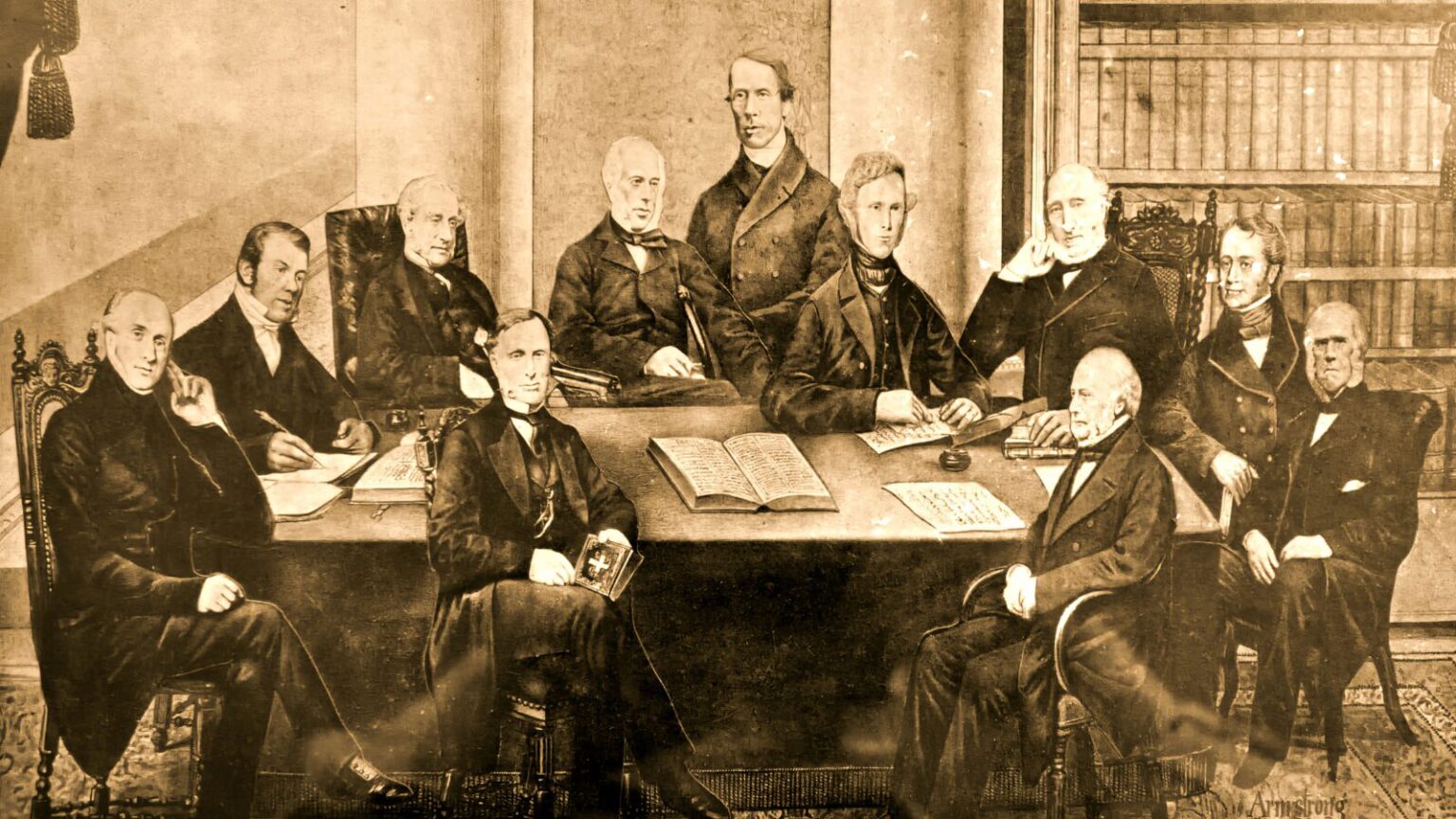
Today, 190 years ago to the day, the Catholic Apostolic Congregations in London solemnly appointed their Apostles—the birth of the apostolate of the modern era. But the further history developed a little differently than expected.
A kind of three-stage plan had developed for the renewed personal occupation of the Apostle ministry in the Catholic Apostolic movement: the first part was the calling of the Apostles, then their consecration, and finally their mission.
The callings had begun on 31 October 1832. And a date had long been prophesied for the consecration too, namely 14 July 1835. The background for this was an interlude from the book of Revelation. It was thought at the time that there should be seven churches in London as well as a group of twelve Apostles. But even on the long-awaited day itself, two congregations were still missing.
No time like the last minute
Things were quite hectic in July 1835. The governing body, the Council of Zion, was meeting daily by the end of it. And ad hoc sermons in the Paddington district and in the more upscale Westminster quarter led to the establishment of congregations that had not yet materialised—or at least to the appointment of their future rectors.
But by the afternoon of the expected date, there were still only eleven Apostles. The twelfth did not want to accept his calling. In keeping with the biblical example of the election of Apostle Matthias, the decision of which of two candidates should be called was decided by casting lots.
In service to all
Now all the signs had been fulfilled: by the evening of 14th July 1835, each of the seven London Angels (these were congregational leaders with the rank of a Bishop) laid hands upon each of the twelve Apostles. By way of this consecration, the Apostles were released from their previous duties in congregational work so that they could now concentrate on the leadership of the church as a whole.
To this end, the Apostles drafted the “Great Testimony”, which called on clergy from around the world to submit to the apostolate. And then they waited for the signal to begin their collective mission—but it was never to come.
Church in crisis
The appeal to the global church of Christ fell on deaf ears. And worse still: one Apostle left, the apostolic unity broke down—and with it the prerequisite for their collective mission. So it was that, from around 1840 onward, the Catholic Apostolic movement fell into crisis.
Things only really started to improve again when the apostolate began to take concrete action once more in 1847—with the apostolic laying on of hands, which is better known today as the act of “sealing”. Apostle Carlyle, who was active in Northern Germany, was very successful. It was also he who advocated that the number twelve be re-established. However, he could not assert himself in the apostolic college.
In the tradition of Apostle Carlyle, who died in 1855, the Apostolic Congregation and, finally, the New Apostolic Church emerged via various intermediate steps. That is why 14 July 1835 is also a significant date for the New Apostolic Church, it says in an official statement of the Work Group History: “Although the two churches clearly differ in terms of their organisation and their liturgy, they are bound by the certainty that the Apostles are essential for the preparation of the bride of the Lord, which is their common task.”
Photo: The Apostles of the Catholic Apostolic Church in a photomontage (without Duncan MacKenzie)