




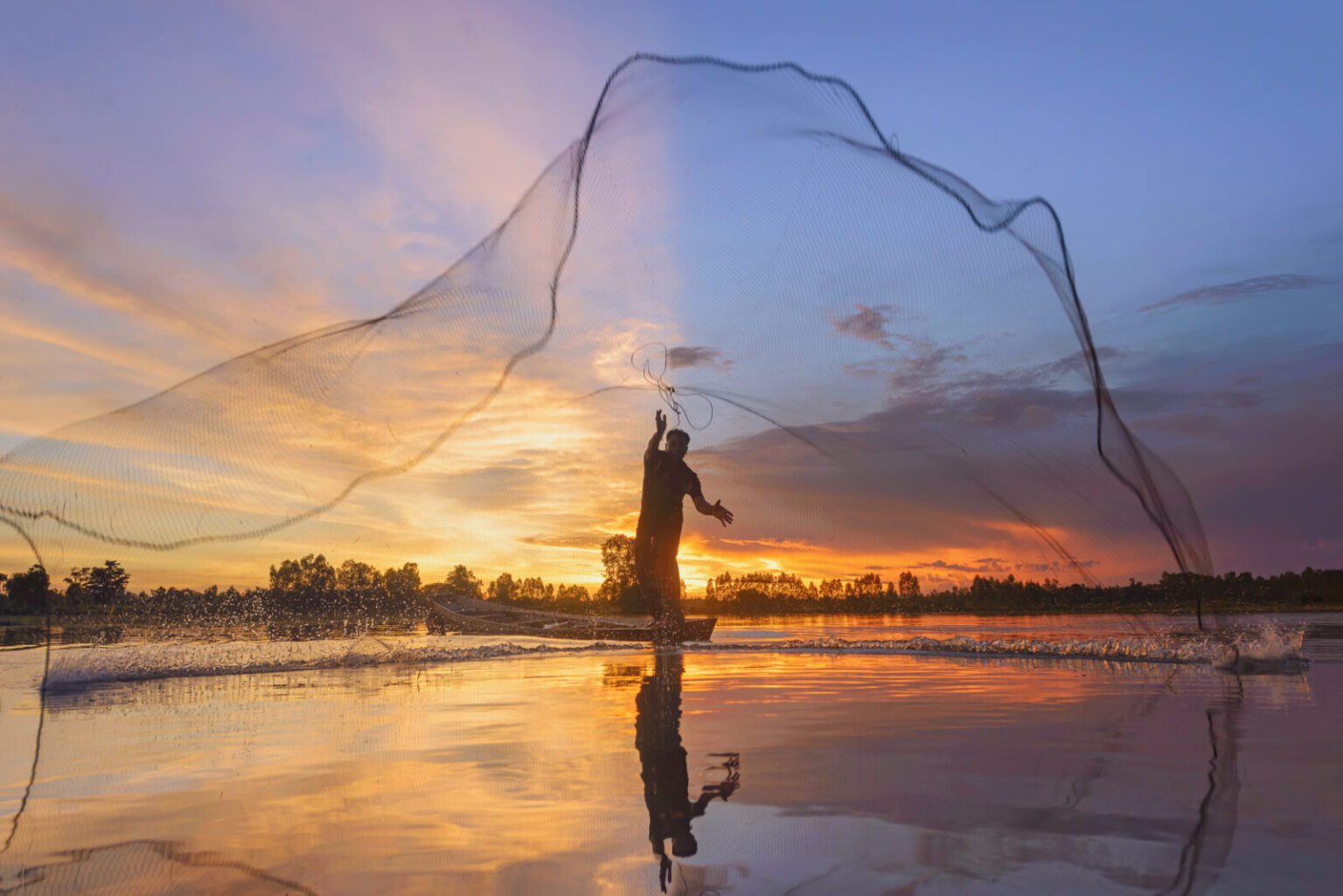
Casting nets to catch human beings? That sounds more like the final judgement than the gospel. But a closer look at the words of Jesus shows that this is a call that saves lives.
A lake as big as a city: what glistens peacefully can change in a matter of minutes. Its unique geography in a low-lying basin allows fierce and sudden winds to descend from the surrounding hills. Then the waters become really rough and towering waves begin to build. So it is no wonder that Lake Tiberias—one of its other names—is commonly known as the Sea of Galilee. It is located below sea level.
A man in his early thirties is walking along the shore. He sees fisherman going about their work and approaches them and says, “I will make you become fishers of men.” Today, this sounds strange, almost a bit like a call to bait, trick, capture, and exploit people.
And for the Jews, shortly before the turn of the century, this must have sounded positively frightening. They were aware of so-called fishermen from the scrolls of the prophets Jeremiah, Amos, and others, who were described as agents of the Last Judgement and were to catch oppressors and all forms of evil with hooks and take them away.
When “catching” means life
But Jesus of Nazareth, who had just taken His first four disciples on board, two pairs of brothers, meant something else. This is reflected in a similar statement on another occasion, “Don’t be afraid. From now on you will catch people,” He says after a first fishing trip that was initially unsuccessful and then ended up to be an overwhelming catch after all.
In fact, it should actually say, “From now on you will catch people alive.” This is because the Bible does not use the normal word for catching or fishing, but zōgréō. And the verb means to “catch alive”, “take alive”, or “capture”. So this was not about death, but about life. The disciples were to win people for eternal life. And today this call is addressed to all Christians.
Learning from the experts
And how do the experts do it? Fishermen do not wait on the shore for the fish to come to them. They know where the fish are and go there. In the same way, Christians do not keep to themselves. Faith happens in everyday life: at school, at work, and among friends.
Anyone who goes fishing needs patience. Not every cast is a success. Sometimes nothing happens for a long time. And then there are times when the net is full again. That is why Christians do not give up so easily and put all their trust in God, to whom they ultimately owe all their success.
Fishermen work together. They work cooperatively, sharing the task, supporting one another when needed, trusting one another, and learning from one another. Likewise, Christians are not meant to stand alone, but are a community. Faith becomes most credible when it characterises an entire community.
Inconspicuous but indispensable
Halieús is the Greek word for “fisherman”— literally “a person whose work is tied to the sea”. Or, if you like a “person of salt”. For the sea and salt are so closely linked that the two share a single word: háls.
So when Jesus speaks of fishers of men, the term “salt” also resonates. Wasn’t there something else in this connection? Yes, exactly: “You are the salt of the earth,” Jesus said to His disciples then, as He does today.
And what does salt do? It spices up life. It preserves. It has antibacterial and anti-inflammatory properties. It melts ice. Salt goes unnoticed, but everyone notices it when it is missing. Christians do not have to be loud, perfect, or the centre of attention. They just have to be there where they are needed.
Photo: SakuraImageInc/Envato