




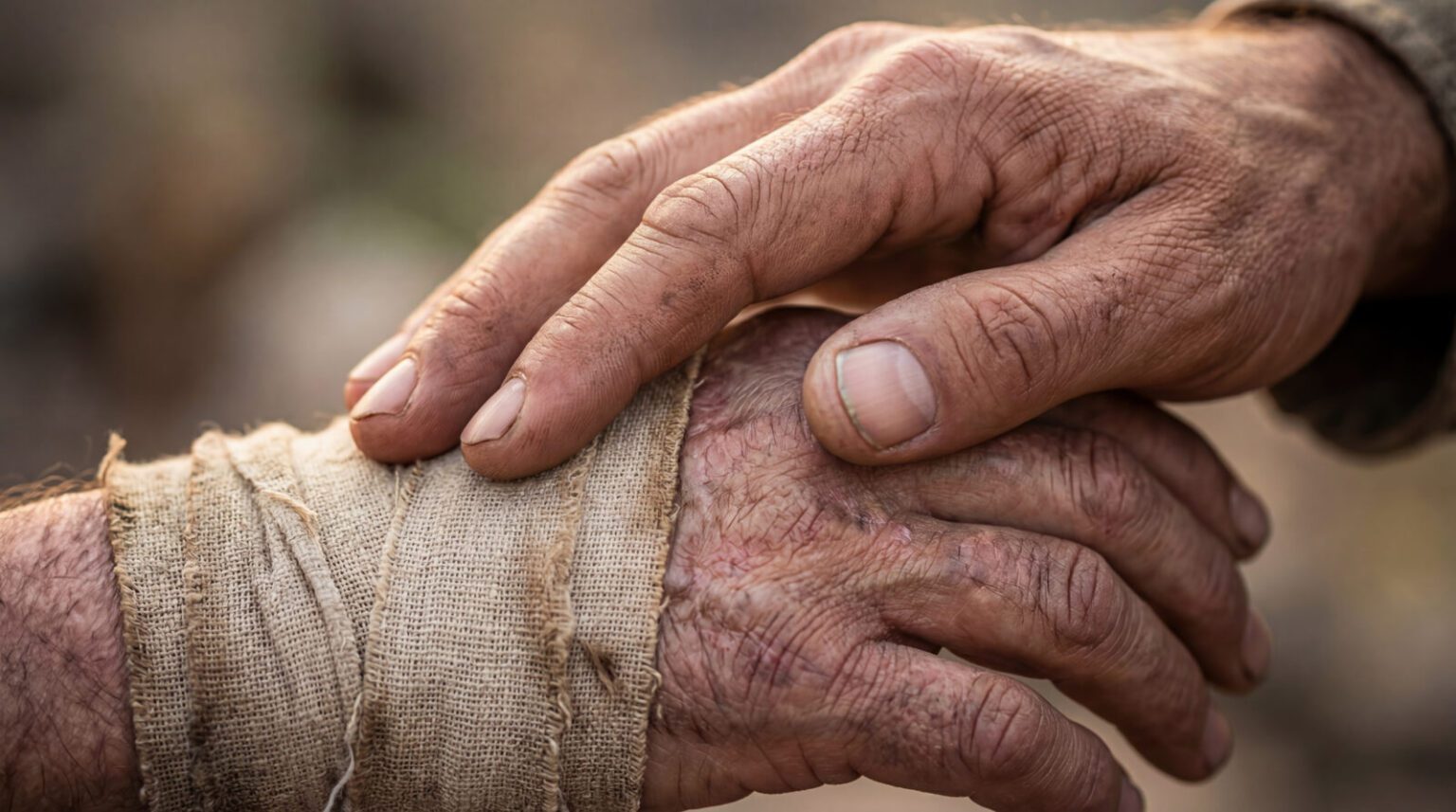
He heals the sick, touches the outcasts, and challenges the devout. But in the end, it says, “Heal yourself!” Why this is precisely what makes Jesus the true healer.
There are doctors who are real experts, truly knowledgeable. But sometimes they lack empathy and beside manner. And then there are physicians who do not merely care for an ailing body but for the whole human being. These we might call healers.
The ultimate model of such a healer is Jesus Christ. This is not only revealed in the many accounts of healings in the New Testament, but also in an incident in which Jesus refers to Himself as a physician.
Scandal at the dinner table
Illness creates distance: no hugs today because of a cold; the masks during the COVID pandemic; the isolation ward in a hospital. And indeed, the Pharisees feared something like contagion: the very Pharisees who insulted Jesus because He associated with questionable people and shared meals with them.
Not only did the highly sanctimonious and overly correct call Him a glutton and a drunkard, they also saw Him as an accomplice of con artists and shady characters. For whoever you shared a meal with, you associated with.
A lesson for the devout
But Jesus had His answer ready, “Those who are well have no need of a physician, but those who are sick.” And then He reinforced His point, “But go and learn what this means: ‘I desire mercy, not sacrifice’” (Matthew 9: 12–13).
This requires an explanation.
- The image of the physician is from Exodus 15: 26: “For I am the Lord who heals you,” God says to the people of Israel after their rescue at the Red Sea. His healing extends beyond individuals to entire nations, addressing not only physical illness but the well-being of the whole person.
- “Go and learn” was a typical phrase used by Jewish teachers to point out to their interlocutors that they had some catching up to do. Jesus instructed the guardians of religion.
- The quotation refers to Hosea 6: 6: “For I desire mercy and not sacrifice.” And sacrifices here refer to obligatory religious practices in general. God wants to see love that is lived, not a pious show.
And that is exactly how Jesus practises medicine, so to speak.
Signs of a new reality
“The blind see and the lame walk; the lepers are cleansed and the deaf hear; the dead are raised up and the poor have the gospel preached to them” (Matthew 11: 5). This makes it clear what this is really about: less about natural well-being than about the glory of God to come. For these healings are the sign prophesied in Isaiah 61: 1 of the coming of the Messiah.
Christ turns to the whole person: He heals the body as well as the soul and spirit. He frees us from fear, isolation, and turmoil. He forgives guilt, failure, and transgressions. He renews the heart, our mind, and the direction our lives are to take. He reconciles us with God, with our neighbour, and with ourselves. He fulfils the hope of resurrection and the new creation.
The Healer’s wound
“Physician, heal yourself!” This proverb will be turned against Jesus Himself. He is aware of this early on (Luke 4: 23). And indeed, as He suffers on the cross, He hears similar things constantly: from the soldiers, from the spectators, from the high priests and scribes, even from one of the men crucified with Him.
But what all these people fail to understand is this: Christ’s sufferings are not those of a sick physician. He Himself is the remedy for a sick world and a suffering humanity. The Saviour offers a healing that makes everything whole again: the salvation of eternal fellowship with God.
Photo: Simon Lehmann – PhotoGranary