




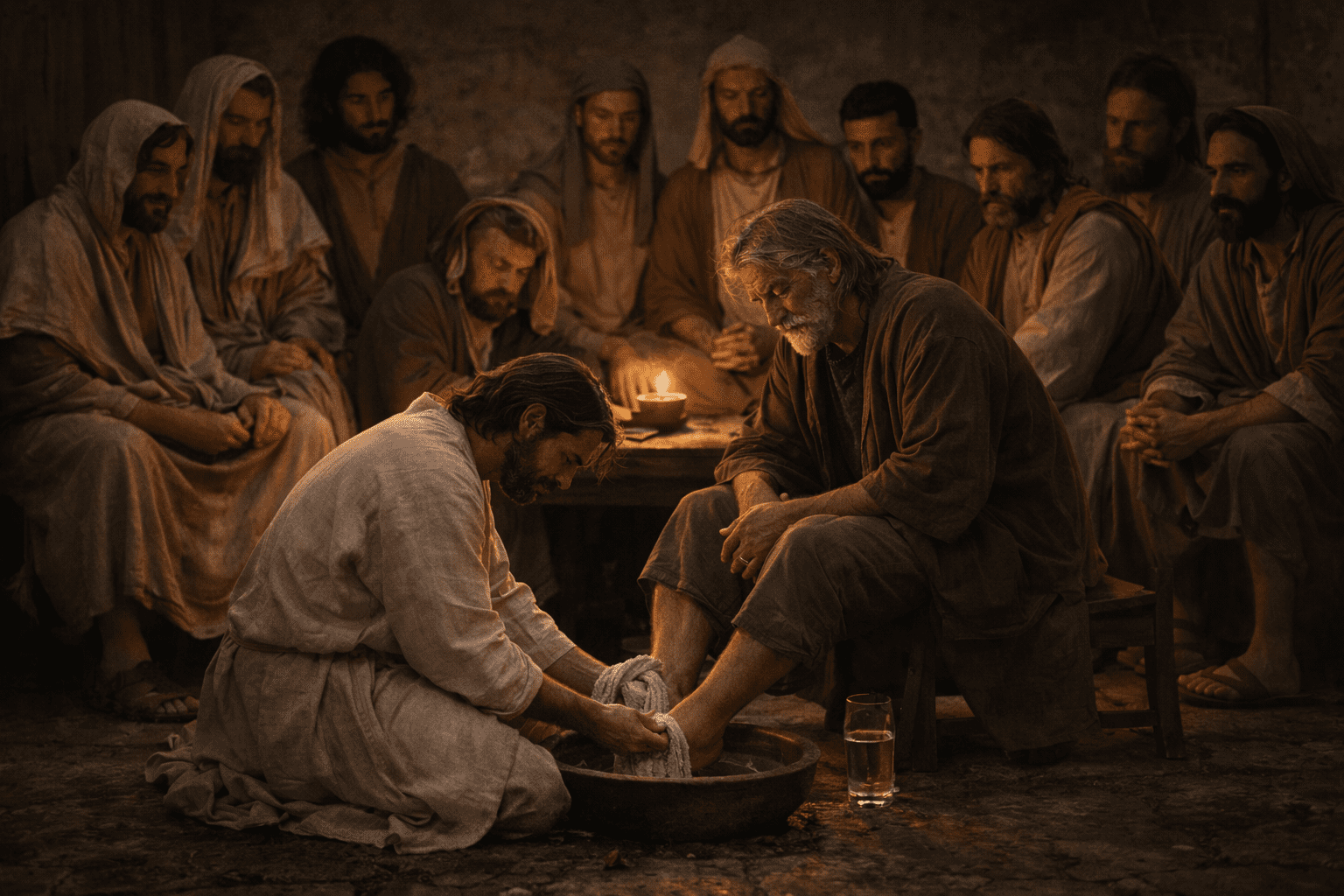
The account of Jesus washing the feet of His disciples reveals the depth of Christ’s love. Even while fully aware of the betrayal and unfaithfulness that lie ahead, He cleanses their feet. In doing so, He sets a standard for all who desire to follow in His footsteps.
The image of Jesus kneeling is one that fills us with awe. The Son of God kneels in front His disciples, pours water into a basin, and begins to wash their feet. What John 13: 5 recounts is far more than a moving peripheral scene to the Passion narrative. This act represents the very identity and essence of Jesus Christ: His love, His humility, and His devotion.
True service does not wait for ideal conditions
Remarkably, Jesus acts with full awareness of what lies ahead. He knows that His time has come. He knows that He came from God and will return to God. And He is also aware of the betrayal that is already looming over Him. That is precisely why the washing of His disciples’ feet is more than a casual gesture or an emotional moment. It is a deliberate act of profound spiritual depth.
Jesus does not serve an ideal, conflict-free group. He serves amid guilt, dark thoughts, and the impending betrayal. He kneels before people who do not really understand Him, who will soon abandon Him, and even before the one person who will betray Him—and does so with full awareness.
It is precisely because of this that His love shines all the brighter. The washing of His disciples’ feet is a sign of the self-abasement of the Son of God. The Lord does not set Himself above others, but places Himself among them. He does not seek the place of honour, but the place of the servant. Divine love knows no distance—it bends down towards human beings, even where weakness, failure, and guilt are already visible.
When humility disturbs
That is the first big message of this scene: Jesus cleanses us. The washing of the disciples’ feet is not merely an act of humility. In fact, it points to what Christ does for humanity. He sees our burdens, divisions, and stains and approaches us precisely when we are at our weakest and lowest moments. It is not we who purify ourselves, but Christ who purifies us.
Peter’s reaction highlights just how offensive this kind of humility is. His resistance speaks volumes: serving others is difficult, but accepting service—especially from Christ—is even more so. How could the Lord stoop to such a demeaning job? Yet it is here that the story reveals its deepest spiritual lesson. Those who seek fellowship with Christ must allow themselves to be gifted, purified, and served by Him. Humanity does not live by its own worthiness, but by the grace of the Lord—a truth that continues to bring comfort to this day.
Jesus does not wait until people have sorted themselves out. He takes the initiative. He serves first. He cleanses first. He extends fellowship first. And it all begins with His love.
An example for His own people
The washing of the feet is not merely a historical event but serves an enduring model. He performs this act on His disciples and calls them to account, and in doing so, issues an ongoing mandate for all future followers of Jesus. On the one hand, the Lord performs this act of humility, on the other hand, He makes His intention explicit, “I have given you an example.” They are to do as He has done to them. What Christ did for them was to shape the way they relate to one another.
This makes the act of Jesus washing His disciples’ feet the definitive model for Christian fellowship. While a community, also a congregation, needs order and clear responsibilities, it does not thrive on hierarchy—only on love that serves. Those who have been served by the kneeling Christ cannot seek to lord it over others and elevate themselves above others.
That is why John 13: 17 is so powerful. Jesus Christ makes it clear: now you know these things. You’ve experienced it for yourselves. If you act accordingly, you will not only be happy but truly blessed. Your life will be affirmed and fulfilled by God. Knowledge alone is insufficient. Understanding humility does not replace living it. Speaking of love is not the same as loving. Action is what matters.
Blessed are those who practise love and humility
Here, the question inevitably arises: Are we prepared to do the same as Jesus did and kneel down? Are we willing to surrender our own primacy, to treat others with love, to bow inwardly where we would rather remain standing, and to undertake even the unassuming tasks that go unnoticed.
True service does not entail a loss of dignity. On the contrary, in Jesus it becomes clear that genuine greatness is not measured by status or rank, but by the freedom to bow down in love. Those who lay down their crown before God do not lose value. Rather, they gain a posture that consciously renounces superiority, making love possible.
It is precisely here that something of the nature of Christ becomes visible. Where people do not seek to dominate but to help each other, togetherness flourishes. And where one values love for a neighbour over personal reputation, the gospel becomes tangible. And when one person is willing to lower themselves to uplift someone else, something of Jesus Himself shines through.
Thus, the washing of the disciples’ feet transcends simple memory, and acts both as a mirror for self-reflection and a criterion for Christian conduct. It reveals the character of Christ and what His followers should become. The highly placed humble themselves. The pure purify. The master serves. And His disciples are called not merely to know this, but to follow Christ’s example and model their lives on it. Christian service does not thrive on the expectation of thanks or recognition, but on gratitude and love. A devotional motto rooted in Protestant social work and ministry sums it up: “I serve neither for wages nor for thanks, but out of gratitude and love. My reward is that I am privileged to do so!”
Photo: AI-generated