




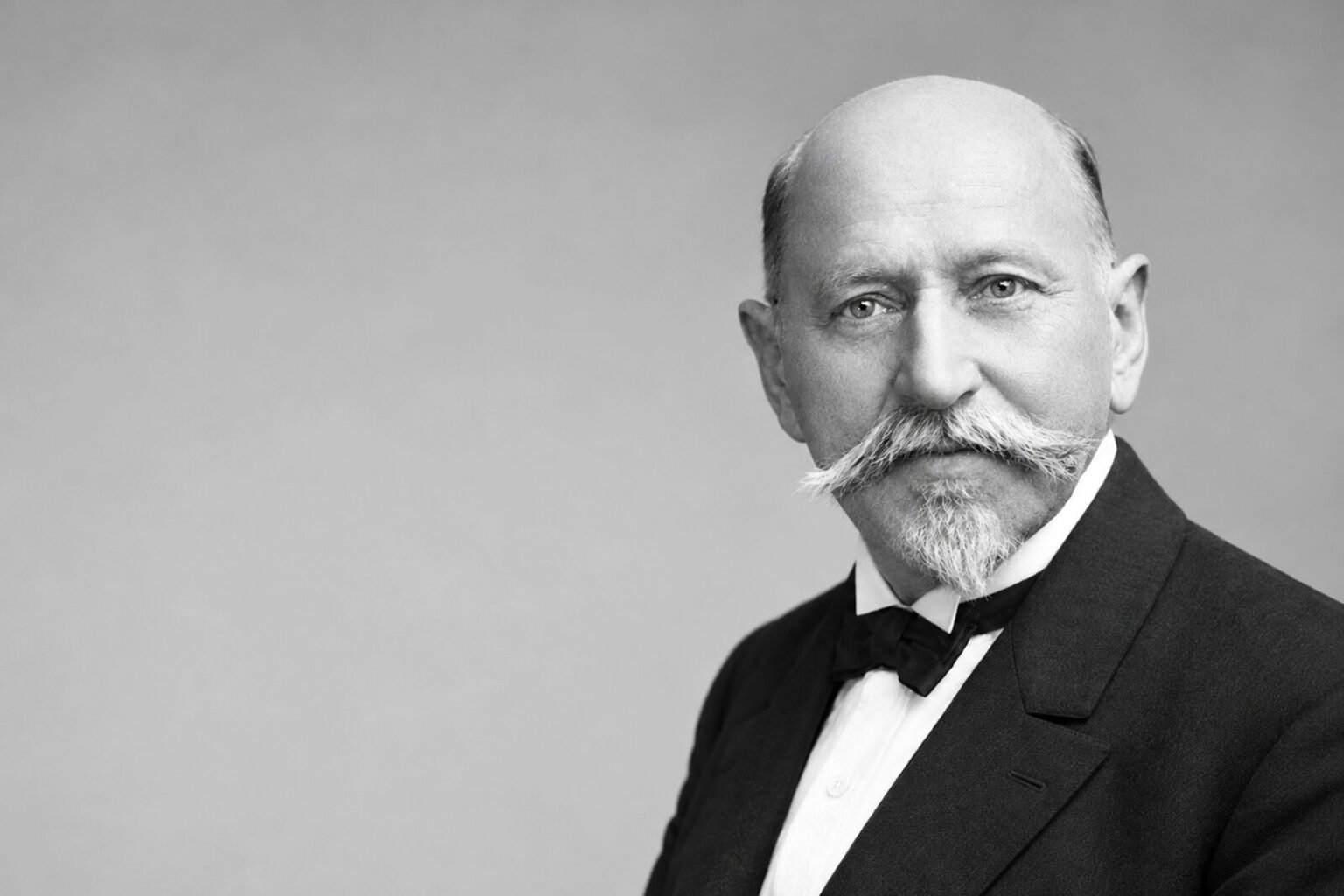
The chapel belonged to a master baker, the congregation paid rent for its own building—and it was not permitted to call itself a “church.” District Apostle Edmund Blöcker changed all that. He retired 100 years ago.
It was 4 October 1926. At his own request, District Apostle Edmund Blöcker is retired. Chief Apostle Hermann Niehaus confers the Apostle ministry to John Lembke. Blöcker’s state of health left him no choice. He served as District Apostle for less than four years, passing away on 6 May 1927. During his tenure, the New Apostolic Church in Hamburg was able, for the first time, to present itself to the state in the manner it had designated itself since its applications for corporate status in 1920: a church. This was a new name—one that church historian Dr. Manfred Henke terms the “real sensation” of those applications. In everyday life, however, it continued to be known as a “congregation” for a long time.
A shepherd comes into his inheritance
Johann Heinrich Edmund Blöcker, born in 1858, served as a Shepherd and rector in the Hamburg-Eimsbüttel congregation. District Apostle Albert Güldenpfennig relied on him—initially for administrative matters and later for pastoral care. In 1918, the Shepherd from Eimsbüttel was ordained a Bishop. When the ailing District Apostle Güldenpfennig was forced to retire completely at the end of 1921, Chief Apostle Hermann Niehaus entrusted the Bishop with the leadership of the district. A little over a year later, he ordained him as a District Apostle. When Edmund Blöcker took office, the district comprised 54 congregations; less than two years later, that number had risen to 83. Yet the new District Apostle had inherited a problem that predated his tenure.
A master baker in the land register
Friedrich Wachmann—who would later become an Apostle—purchased the chapel on Alfredstraße in Hamburg-Borgfelde in 1893, having the title registered in his own name, “given the circumstances,” as Dr. Henke writes. Those circumstances involved the fact that the congregation was legally barred from holding property. Consequently, a master baker—Wachmann ran his bakery next door—was listed in the land register, while the congregation paid 2,000 Marks in annual rent for its own place of worship. This was not a unique situation confined to Hamburg. In Great Britain, the birthplace of the Apostolic movement, only the Church of England and the Church of Scotland were established by law. Other churches did not exist as legal entities, and their property was held by trustees. The Catholic Apostolic mother church paid a heavy price for this arrangement: once the last of its ministers had passed away, trustees authorised the demolition of the churches or transferred them to other parties. Only a single congregation in London remained.
When the Hamburg congregations sought to register as an association—at the very least—in 1911, the political police lodged an objection, at the behest of Prussia, whose territory effectively surrounded Hamburg. It was not until the end of the monarchy that this obstacle was removed. The “New Apostolic Congregation” was entered into the register as a registered association [“Neuapostolische Gemeinde eingetragener Verein”] on 9 December 1921 (Hamburg State Archive, 231-10 B 1973-186)—but as a congregation, not yet as a church. District Apostle Blöcker set priorities: in 1922, he first purchased a residential building that incorporated a meeting hall in Harburg, followed two years later by the Borgfeld Chapel for the church. Securing a hall for Harburg was “more urgent to him than settling the property arrangements in Borgfeld,” observes Dr. Henke.
“A mockery of the constitution”
A registered association can hold property. What more can a public-law corporation do? Legally, it stands on the same footing as the state churches. Article 137 of the Weimar Constitution opens the door: “Other religious societies shall be granted equal rights upon their application, provided that their constitution and the size of their membership offer a guarantee of permanence.”
The federal states decide on the applications. District Apostle Johann Gottfried Bischoff had applications submitted in Baden and Prussia immediately after the constitution came into force. Baden granted approval within a year. Prussia—where, until 1918, only the established state churches were permitted to call themselves “churches”—proved more difficult. New objections, new drafts of the constitution, memoranda for official use—the process dragged on for years. In early 1925, the church’s lawyer, Dr. Jacob Flesch, lost patience, expressing: “This makes a mockery of the constitution.”
Hamburg needs 107 days
While Prussia dragged its feet, Hamburg moved quickly. District Apostle Blöcker submitted the application on 17 January 1925. The judicial administration, the senate, and the parliament acted swiftly, but state church bodies were not consulted. The applicant witnessed the final act from his sickbed—District Apostle Blöcker suffered a stroke in mid-April, the evening before the Chief Apostle was due to arrive in Hamburg for a service. On 4 May 1925, the Senate promulgated a law consisting of a single article: “The New Apostolic Church within the territory of the State of Hamburg is granted … the rights of a public-law corporation in accordance with its constitution of 8 March 1925.” It took 107 days from the application to the enactment of the law—whereas Prussia had spent nearly five years without reaching a decision.
This success in Hamburg did not set a precedent, however. Bremen, Oldenburg, and Mecklenburg-Schwerin—also part of the district territory—declined. Lübeck and Württemberg waited for Prussia to act. Church historian Henke summed up the situation as follows: “Until the reorganisation of the state structures in the Federal Republic of Germany, recognition … remained limited to Baden and Hamburg.” District Apostle Blöcker was still in ministry when the first rejections were received.
A German legacy
Today, all German Regional Churches hold this status, and the basis remains the same as it was in 1925: the basic law of the land incorporated the church-related articles from the Weimar Constitution into Article 140. It is up to each church to decide how to utilise this status. The church tax, for instance, was included as a precautionary measure in a 1921 draft bill by a Prussian ministry official, even though the church had never sought it. The same holds true today: the New Apostolic Church does not levy taxes on its members.
The ecumenical recognition achieved in 2026 follows the legal recognition granted in 1925: as of 1 July, the New Apostolic Church is a full member of the Association of Christian Churches in Germany (ACK), a milestone celebrated during a service in Berlin on 16 September. It took a century in Germany to progress from state recognition as a church to recognition by other churches—with the final stretch involving a quarter-century of relationship-building, ranging from initial talks within a regional ACK chapter in 2001 and years of theological dialogue to guest membership in 2019.
In other places, it is called something else
Corporate status in this form is a German peculiarity. Elsewhere, different paths lead to the same goal. In Austria, the New Apostolic Church has been a legally recognised church since 1975. In Switzerland, where the New Apostolic Church International is also headquartered, it is an association.
In Zambia—formerly the British colony of North Rhodesia and today home to one of the Church’s largest regional congregations—the Church has been officially recognised by the state since 1929, just one year after the first congregation was established. The Church itself mentions this quite matter-of-factly on nak.org: in other countries, it is “officially recognised in a legal form compliant with local laws.” What was accomplished in Hamburg in a single spring took decades—or has yet to happen at all—in other places.
Two words and a police officer
Two words still bear traces of the era prior to 1919. The Prussian Law on Associations of 1850 required statutes, membership lists, and a presiding officer (rector). Officially, only “members and their guests” were admitted to meetings, and the police could send a uniformed officer to listen in. Although the term “rector” predates Prussia, Dr. Henke nonetheless sees the imprint of that law in New Apostolic practice: “When New Apostolic congregations are led by a rector today and welcome ‘guests’ to their services, hardly anyone realises the fact that these are terms originally imposed on the congregations by the Prussian authoritarian state.” Both terms—introduced into the land register and the official gazette by Edmund Blöcker—have remained within the Church. The police officer at the hall door has not.
The complete essay by Dr. Manfred Henke, “100 Years Ago – The ‘New Apostolic Church in the Hamburg state area’ becomes a ‘Public Law Corporation’”* is available for download.
* “Vor 100 Jahren – Die ‚Neuapostolische Kirche im hamburgischen Staatsgebiet‘ wird ‚Körperschaft des öffentlichen Rechts”
Photo: Archive