



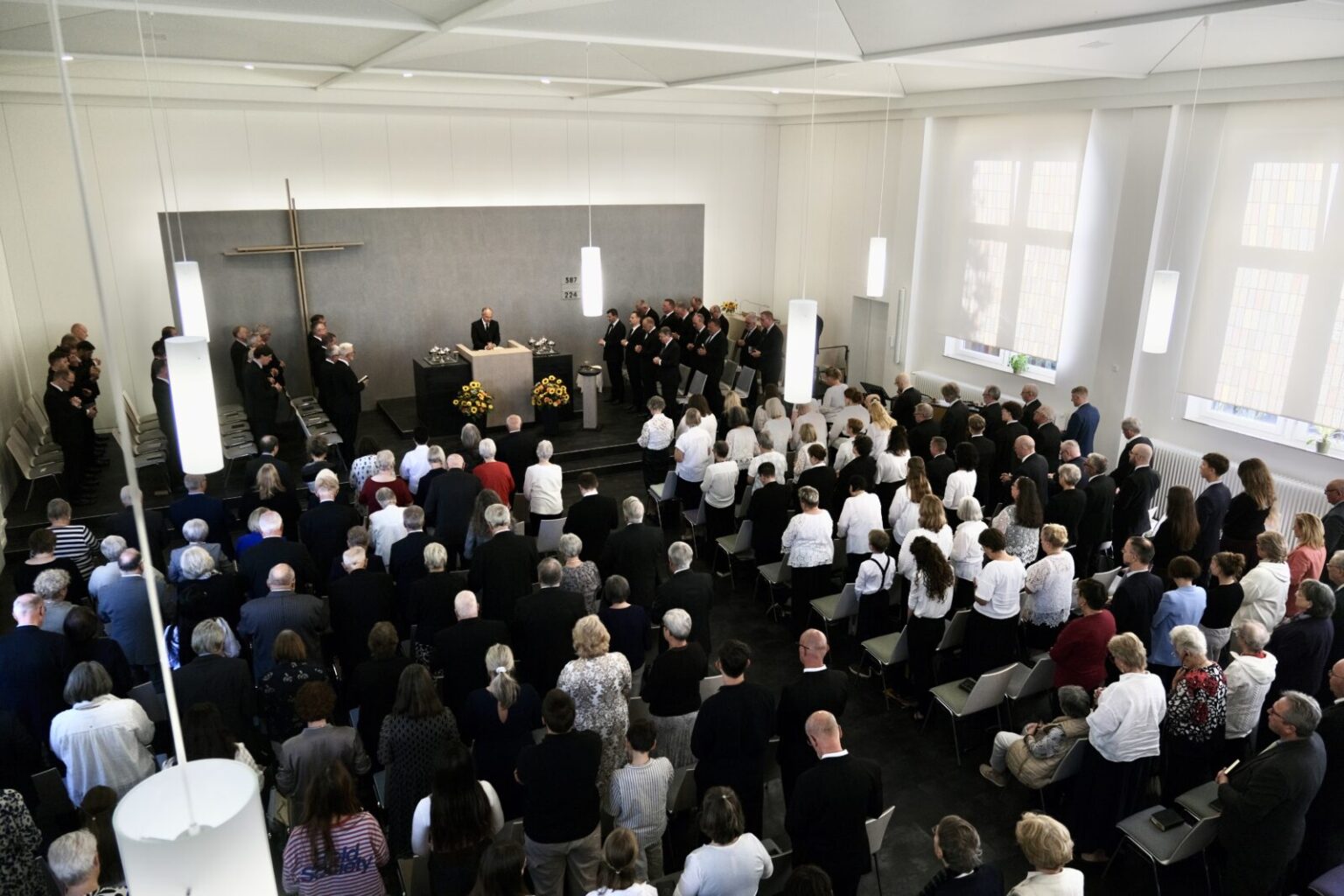
He possesses more than he needs. Yet he lacks what matters most. In Oldenburg, Chief Apostle Helge Mutschler explained what the rich farmer teaches us about the kingdom of heaven.
A person who possesses much yet lacks the essentials: this was how Chief Apostle Helge Mutschler described the rich farmer in a divine service in Oldenburg, Germany, on 6 September 2026. “The Lord Jesus wanted to explain heaven to us human beings through parables.” So what does this man’s lack reveal about God’s riches? “This parable is a parable that helps us discover heaven,” he explained, referring to Luke 12:16–18.
Richly blessed without realising it
“He was a rich man whose land had produced abundantly.” The farmer was delighted with his record harvest without realising where his wealth came from. Or, as the Chief Apostle put it, “What a poor man this rich man is.”
In the kingdom of God, things are different. “Everything begins with a gift.” This is a fundamental message of the gospel: “The land had produced abundantly. That is the gospel. This is God’s principle: God is the giver.” God does not give sparingly, but in a “good measure, pressed down, shaken together, and running over” (Luke 6: 38). Above all, He bestows “grace upon grace. And even more grace on top of that, in overflowing abundance, in superabundance.”
This also applies to people who currently see nothing but a barren field before them. No one needs to earn God’s love, the Chief Apostle said. “You do not need to strain yourself or try to prove yourself to God in any way. This God, your God, loves you even when you cannot see it or realise it at the moment.”
An inner monologue that leads to loneliness
In days gone by, it was customary to discuss important decisions with the village elders, the Chief Apostle explained. However, this poor rich man speaks neither to others nor to God. He organises everything on his own, even the feast he intends to enjoy later. “Happy, all by himself.”
Jesus, by contrast, “always enjoyed being with people and would sit down at the table with them—with tax collectors, with sinners, with everyone—and eat and drink with them, finding joy in their company.” Even on the cross He cried out to God (Matthew 27: 46).
“This is God’s principle of fellowship, closeness, and relationship. You do not have to be alone, and you are not alone,” the Chief Apostle assured his listeners. Even those who feel abandoned can call out to God: “There is always someone to whom you can speak, someone you can perhaps even cry out to, ‘My Lord, my God, my God!’”
This is another reason why pastoral care is so important. “That is why we are committed to saying, ‘Yes, we want to strengthen pastoral care’, because we are preparing for heaven.” In this fellowship, heaven can already be experienced today. “And that in itself is already heaven: that we come together, strengthen one another, share our plans and questions, talk about our worries, sufferings, and sorrow, and are there for one another and with one another.”
“For the good Lord does not want us to sit there all alone, wretched, abandoned, and lonely.”
Bigger and bigger … but what for?
The barns are too small, so bigger ones need to be built. How big? The main thing is that they are bigger. “This is a reflection of human nature, perhaps particularly that of modern humankind.”
“Everything has to keep getting bigger, without limits; always bigger, always faster, always higher, and always further.” And share prices must rise, and everything must keep growing. This poor rich man is trapped in a life of excess, driven by a greed that is never satisfied. In the kingdom of God, things are different.”
Jesus Christ took the opposite path: He left heaven and humbled Himself (Philippians 2: 7).
This raises a personal question: “What is my barn? What is it in my personal life that I always want to make ever higher, faster, bigger, and more far-reaching? In what area of my life must I acknowledge that all sense of proportion has been lost, that there is no longer any middle ground, and that striving and desire have become endless?”
People are afraid, the Chief Apostle said— afraid of life and, ultimately, of death. They accumulate possessions and protect themselves.
Fear lies behind this relentless drive, and no barn can protect us from it. God provides for even the ravens without their having to store up provisions (Luke 12: 24). The kingdom of God is humility and trust.
The rest that need not wait
“Once I have built all my bigger barns, once I have gathered everything together, then I finally want just one thing: to take it easy!”
A familiar thought. First, finish this project, complete that task, and achieve that goal. Then things will quieten down. Really?
The Chief Apostle once again referred to the words of Jesus: “Come to Me, all you who labour and are heavy laden, and I will give you rest” (Matthew 11: 28). Plans must not turn into a hamster wheel. The rest that Christ offers is already available to us.
An inheritance that does not diminish
Ultimately, God will ask who owns the accumulated wealth. The Chief Apostle rephrased the question in modern terms: “You rich person, I think you have seriously miscalculated. Let us suppose, purely hypothetically, that you were to die tonight. What would become of all the stuff you have accumulated? Who would own it all? Who owns everything you have gathered?”
The parable says nothing about heirs. In the kingdom of God, however, Christ prepares a place for His followers in His Father’s house (John 14: 2), makes them joint heirs (Romans 8: 17), and will take them to Himself (John 14: 3).
Thus, the parable reveals not only where the farmer goes wrong, but also what God gives: grace rather than the pressure to perform, fellowship rather than loneliness, humility rather than delusions of grandeur, peace rather than restlessness, and an inheritance that Christ shares with humanity.
Fotos: Neuapostolische Kirche Nord- und Ostdeutschland, Manuel Luikenga