




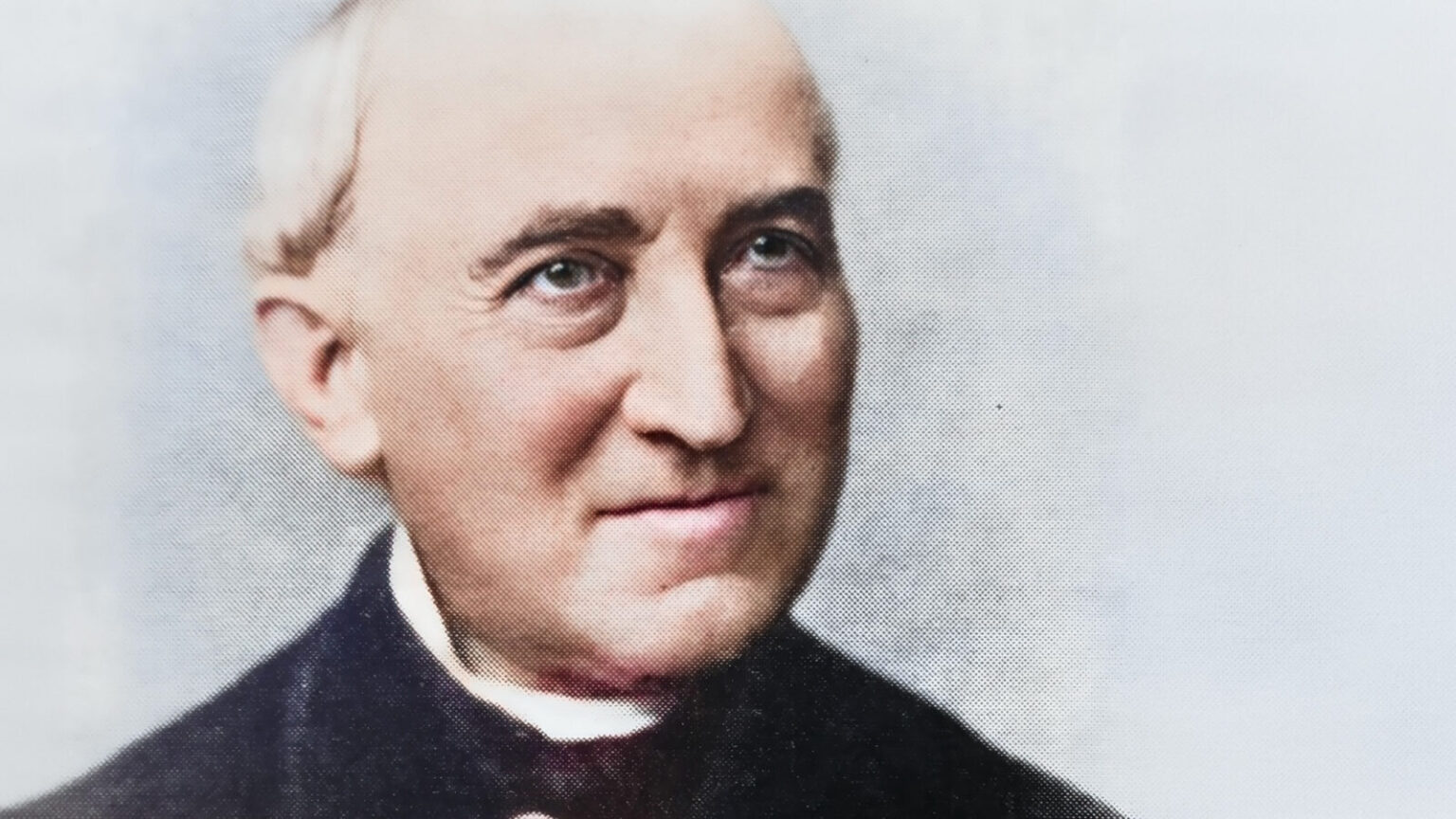
Gravestones tell stories, but not always the right ones. This can even upend an anniversary feature, like the one about Apostle Menkhoff and his birthday—a historical detective story.
“You’re a little late.” When the email containing this sentence arrives, it is clear: forget the research and shelve the story.
This was actually supposed to be a tribute marking the 200th birthday of Apostle Friedrich Wilhelm Menkhoff, an iconic figure of the New Apostolic faith who shaped the Church liturgically and culturally like few others.
But then there was this vague nagging feeling: anniversary, is that really the correct date? Wasn’t there something about it? A quick double-check and a Google search later, the dates just tumbled in. 2 June 1826, 2 February 1826, and then even 27 May 1824. Um, which is it then? And then the work really began.
Chaos in the calendar
Manfred Henke has systematically documented the confusion. He is a retired minister and a recognised Church historian specialising in the New Apostolic and Catholic Apostolic Churches. In his—as yet unpublished—book with the working title Truly Apostolic? – The New Apostolic Church in the Nineteenth Century, he has devoted a substantial footnote to Menkhoff’s birthday problem.
27 May 1824, “Register of Apostles” of the International Apostles’ Unity states. Yet the second edition, revises the date to 2 June 1826. The same date appears in the loose-leaf collection Apostles of the End-time published by Bischoff-Verlag. The standard work Die Katholisch-apostolischen Gemeinden in Deutschland by Johannes Albrecht Schröter, however, mentions 2 June 1824 (a different year). And the most recent publication Nieuw licht op oude wegen (New Light on Old Paths) by Berry Brand, cites 2 February 1826 (a different month).
Well, good to know—but not all that helpful either.
Back to the sources
“Wilhelm Friedrich Menkhoff was born on 27 May 1824,” Mathias Eberle writes in his master’s thesis, which focuses on the early activity of the future Apostle as a Protestant Deacon. The chairman of the Apostolic History Network backs up his statement with sources: “See the Wallenbrück church register, p. 113, No. 45.”
Manfred Henke nods in agreement. And his footnote cites a second source: “Menkhoff’s date of birth, as recorded in the Wallenbrück parish register, is confirmed by the entry regarding Menkhoff’s marriage, Historisch Centrum Leeuwarden, archive number 1002, inventory number 3584: Huwelijksregister 1859 Leeuwarden, No. 24 confirmed.”
And Alfred Krempf, head of the Central Archives of the New Apostolic Church in Western Germany, adds a further source for 27 May 1824. This is also documented in the description of individuals listed in the population register held at the Amsterdam City Archives.
An error carved in stone
So far so good. But where does the incorrect date come from?
The source of the confusion is a gravestone—or rather, Apostle Menkoff’s memorial monument—“an imposing obelisk situated in the centre of the private cemetery in Gadderbaum, Bielefeld”, as Mathias Eberle describes it. Here we find the following incorrect date: 2 June 1826. But how can something like that happen?
“Such errors are common when restoring faded inscriptions or (as the appearance suggests may have happened in this case) when an old gravestone is replaced with a new one,” Henke’s unpublished manuscript explains.
Anyone wishing to learn more about the work of Apostle Menkhoff can find additional material here and here. But please note: the date of birth is incorrect. In fact, Friedrich Wilhelm Menkhoff was born on 27 May 1824—at six o’clock in the morning, according to Henke.