




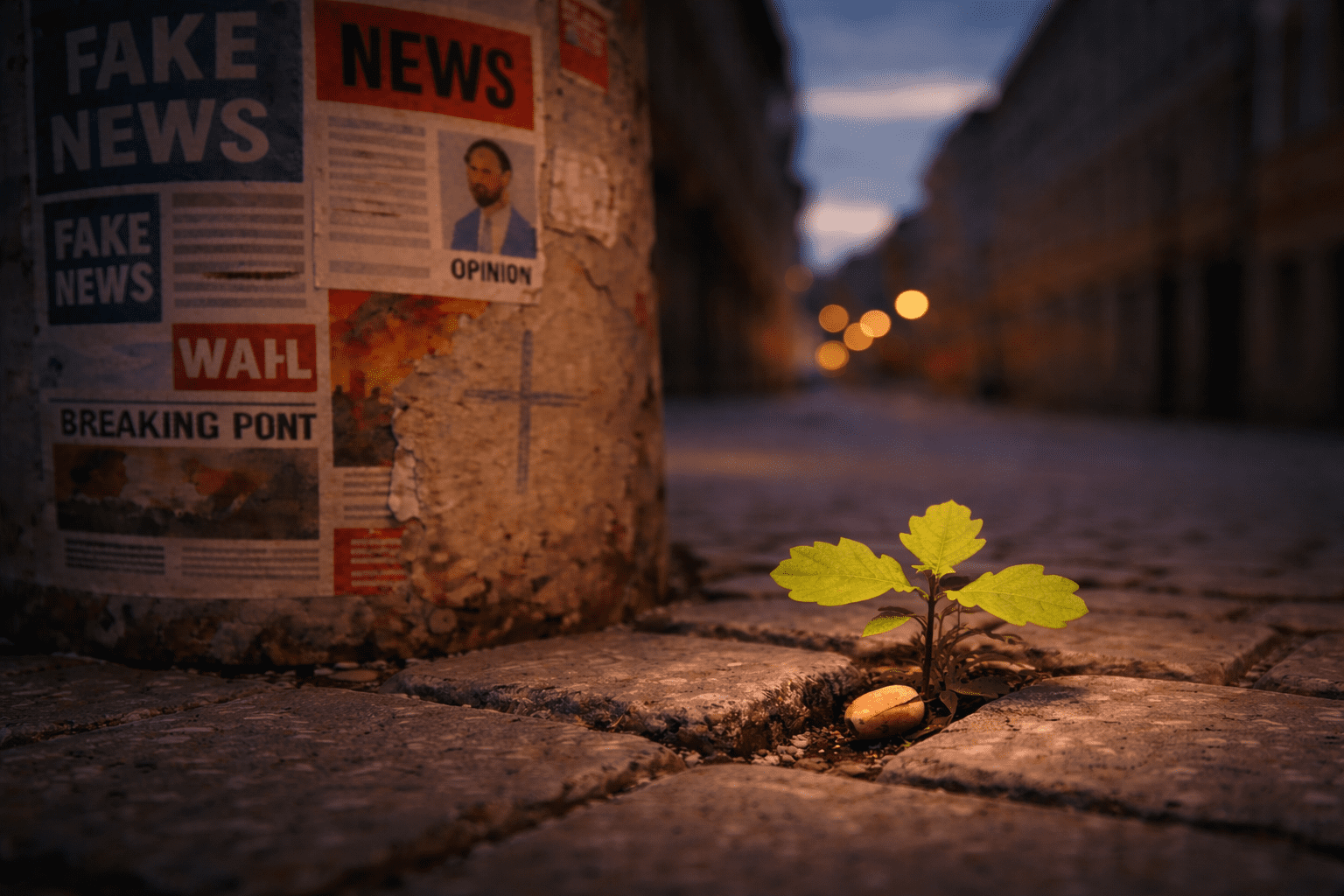
A pastoral conversation with Jesus, without a quick solution. Where there is enough room for questions without shame, faith can grow. This often happens in secret, and sometimes only after a long time.
Nicodemus did not seek Jesus where the crowds were listening. He came at night. Not to test Jesus, but likely to avoid scrutiny from his peers.
He was a respected member of the Jewish ruling council. Someone who knew how to believe. Someone who knew how to talk. And above all, someone who knew what the Pharisees and scribes viewed Jesus.
A cautious search
Nevertheless, he went to see Jesus—the one whom he recognised as having been sent by God and yet was unsettling in His presence. Because some questions require a protected space, a place where one can say, “I don’t understand.”
That specific night became such a space.
- What counts here is not how confident you sound, but that you are allowed to ask honest questions.
- Here, immediate understanding is not demanded, and no one judges uncertainty.
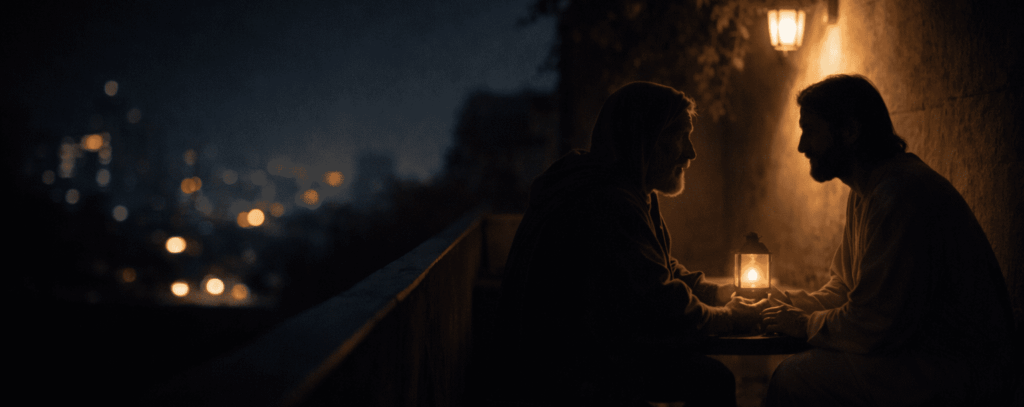
Who doesn’t know nights like these? Questions left unspoken because the words have not formed, because you feel exposed, and because you think you should have understood long ago.
Nicodemus found the right space for this with Jesus: a safe space for doubt, openness for questions, and a space where he knew his own perspective would be respected.
Less telling. More relating.
Jesus did not respond with distance, even though the timing of Nicodemus’ visit might have suggested that He should be more cautious. Nor did He expose or shame Nicodemus or use the encounter to prove a point against a scholar. Jesus took him seriously.
Nicodemus began politely, almost formally, feeling his way forward. But Jesus did not remain on the surface. He led the dialogue to the innermost core, the foundation of life. He told him that it was not enough to know about God, but that it was crucial to enter into a relationship with Him.
Jesus did not give Nicodemus a package of ready-made answers. He opened a horizon, speaking of a new beginning, of life from the Spirit, and a faith that grows from trust, not control. And He spoke in such a way that Nicodemus was allowed to think for himself—even if he did not (yet) understand.
Jesus did not put pressure on Nicodemus but treated him with respect and enlightened him. He inspired, asked questions, and left space for reflection. The impact ran deeper than the conversation itself.
At first glance, nothing seemed to have changed. Nicodemus did not abandon his former life as others did. Nor did he immediately become a disciple of Jesus. For the moment, their encounter remains a first conversation—cautious tentative, almost a testing of the ground.
When faith has not yet found its voice
However, Nicodemus does not simply fade from the narrative after that night-time encounter. Initially, all remains quiet around him. No clear decision, no public commitment. He does not leave his nets, so to speak, to follow Jesus. And yet something stirs within him. Change takes time. The narrative in the gospel of John jumps from the early phase of Jesus’ ministry to the Feast of Tabernacles—this is months, perhaps years later.
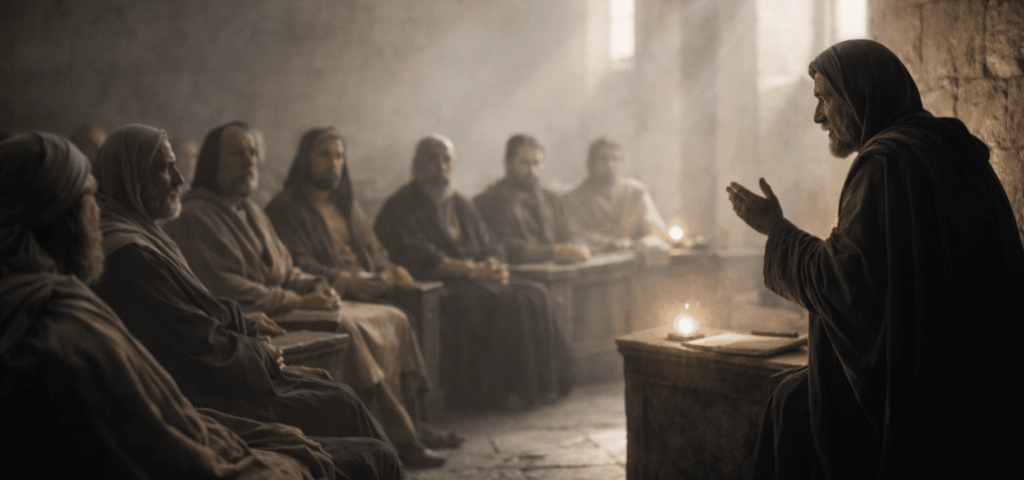
When Nicodemus reappears, it is no longer about a personal conversation, but about a judgement. In the midst of those who sat in judgement over Jesus, Nicodemus remained cautious. He reminded them of fairness, justice, and the correct procedure to be followed in such cases. It was not a courageous appearance. He did not become a fiery defender of Jesus. But it was another step and a visible echo of the night-time conversation. Nicodemus thought differently. He argued differently. His faith remained searching—but not without consequences.
Often, we expect immediate, dramatic transformations. We think in terms of “Saul to Paul”, anticipating a sudden turnaround. But a transformation often begins with small shifts: in tone, in attitude, in the willingness to honour another perspective. Pastoral care is not always visible, yet it can leave its mark—quietly, persistently, and lasting.
Royal honours: when faith becomes visible
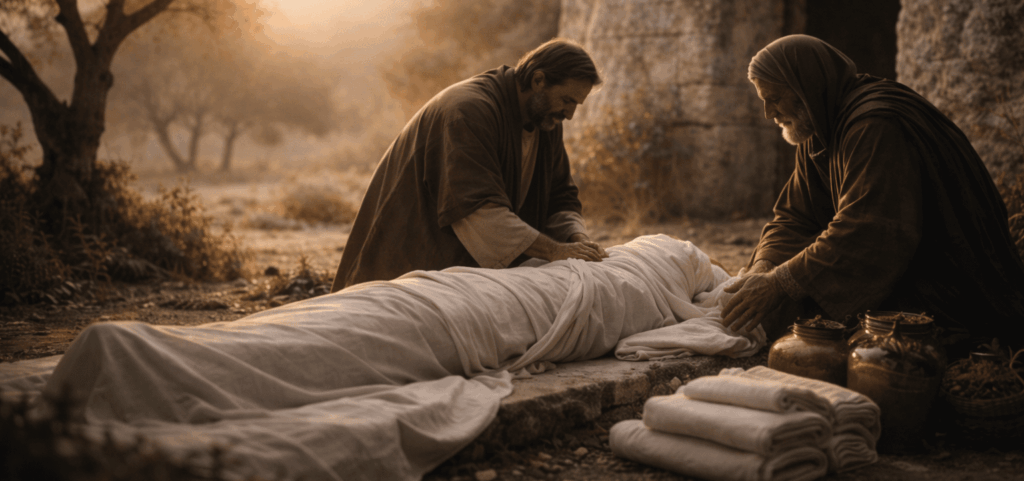
While the disciples withdrew in fear, Nicodemus and Joseph of Arimathea stepped forward. Not with words, but with an act that made visible what had matured in secret. Together they saw to it that Jesus received a proper burial.
Nicodemus brought a large amount of myrrh and aloes. This was no small gesture, but an honourable burial testifying to deep reverence. What once had begun with questions had found a form here that needed no further explanation. No words, no profession of faith, no justification. Just this one act.
It is striking that Nicodemus did not become a preacher. He did not give a speech. Nor would he later become an Apostle and carry the gospel to the whole world. His faith manifested itself differently—in a calm, dignified, and determined manner. There was nothing more to be gained.
The way out of the night did not lead to a stage, but to a grave. And it is there that what has grown in conversations becomes visible—over months, perhaps even years.
Nicodemus reminds us that faith is not always loud, but it becomes concrete.
And he reminds us that faith needs relationship: a space where honesty lives. Pastoral care keeps this space open even when the results take time. Growth often happens quietly and slowly, sometimes almost unnoticed. But it finds its way:
“The kingdom of God is as if a man should scatter seed on the ground, and should sleep by night and rise by day, and the seed should sprout and grow, he himself does not know how.”
(Mark 4: 26–27)
Photo: AI-generated