




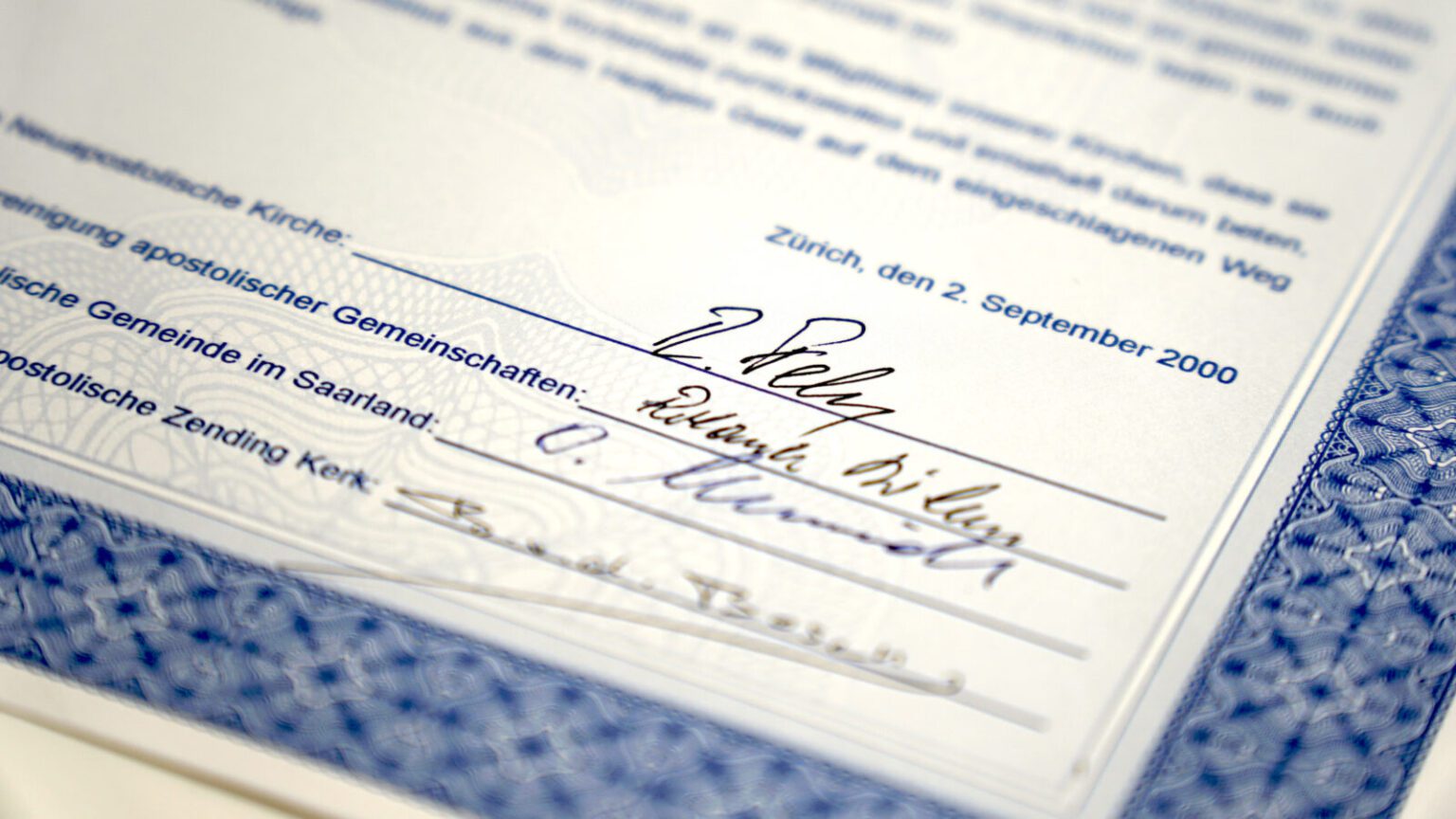
It was a milestone on a long and bumpy road: the first Council of Apostolic Denominations on 1 and 2 September twenty-five years ago. Here is what happened and where it has led.
“Sharing prayer-work” is written by hand in the margin of the meticulously planned agenda. From the welcome gifts in the hotel room to the colourful row of name cards at lunch and dinner—nothing was left to chance.
There were around two dozen active groups in the apostolic denominations in Europe, which had emerged in one way or another from the New Apostolic Church (NAC) and its predecessor organisations. Discussions had been ongoing in the Netherlands since the mid 1980s and in Switzerland since the late 1990s. And there were also contacts in Germany—at least on a personal level.
It was within this circle that the idea of a joint conference was born. And so, in a letter dated 31 January 2000, Chief Apostle Richard Fehr invited everyone to a council in Zurich. “A joint look back can prepare us for a joint look ahead, perhaps even to a time when brotherhood can once again reign among all apostolic communities,” he stated, explaining the agenda.
The desire for reconciliation
The invitations were accepted by the Hersteld Apostolische Zending Kerk (HAZK) from the Netherlands, the Apostolische Gemeinde des Saarlands, and the Vereinigung Apostolischer Gemeinden (VAG), representing a whole range of independent groups. A total of eight representatives from different apostolic denominations met with seven representatives of the New Apostolic Church on 1 and 2 September 2000.
On the dinner menu that Friday was veal scallops in tarragon sauce. The actual meeting only started on Saturday at nine o’clock with a prayer and a speech by Chief Apostle Fehr. “I hope that this Council will take us a little further along the path to reconciliation,” he said, admitting that “mistakes have also been made in our Church and will likely continue to be made in the future”.
A joint declaration
The participants looked back on New Apostolic history, including the dismissal and expulsion of District Apostles Brückner (1921) and Kuhlen (1955). Apostle Roland Böhm (VAG), who took the minutes, emphasised that the times called for “apostolic witnesses”. And Apostle Werner Weise (VAG) asked about the common foundations of faith, which led the group to the heart of the matter.
Finally, the participants adopted a joint communiqué with three points: we see similarities and respect differences; the aim is to sound out the extent to which cooperation is possible; and they expressed the “special wish that the members of our churches set aside any reservations they may have”. How justified the latter passage was would soon become apparent.
Mixed reactions
The conclusion of the participants was very positive: “The atmosphere between the four apostolic churches was very relaxed,” the Hersteld Apostolische Zending Kerk from the Netherlands wrote in the September issue of its periodical Peace be with you! “The communiqué was characterised by a good spirit,” the Vereinigung Apostolischer Gemeinden (VAG) confirmed in the November issue of its monthly magazine Herold.
At the same time, though, the council caused unrest among church members. Rumours of a merger between the various denominations began to circulate. And the Vereinigung Apostolischer Gemeinden (VAG) felt compelled to issue a clarification: “We know from the discussions that have taken place so far with the New Apostolic Church that such an approach does not reflect the views of the leadership of either of our churches,” the Herold emphasised in June 2001. And indeed: the District Apostle Meeting was hesitant and cautious.
The unrest was fuelled by “counterproductive statements and malicious publications on the internet”, both the VAG and the NAC stated at a follow-up meeting. However, the leaders of both denominations were unperturbed by this.
On the road to reconciliation
It was agreed that the term “council” was a little bold. Following a new round of talks in May 2001, the “councils” were demoted to “working meetings”—and referred to as such from then on. And a survey at the beginning of 2003 showed that it would be more effective to hold further talks bilaterally.
And so what the Vereinigung Apostolischer Gemeinden (VAG) had already predicted in the November issue of the Herold about the first apostolic council came pass: “This meeting in a larger circle can only be seen as the first step on a long road.” The apostolic denominations reached their goal with their Statement of Reconciliation in 2004 in Switzerland, 2014 in Western Germany, and 2017 in Eastern Germany.
Photo: Andreas Rother