




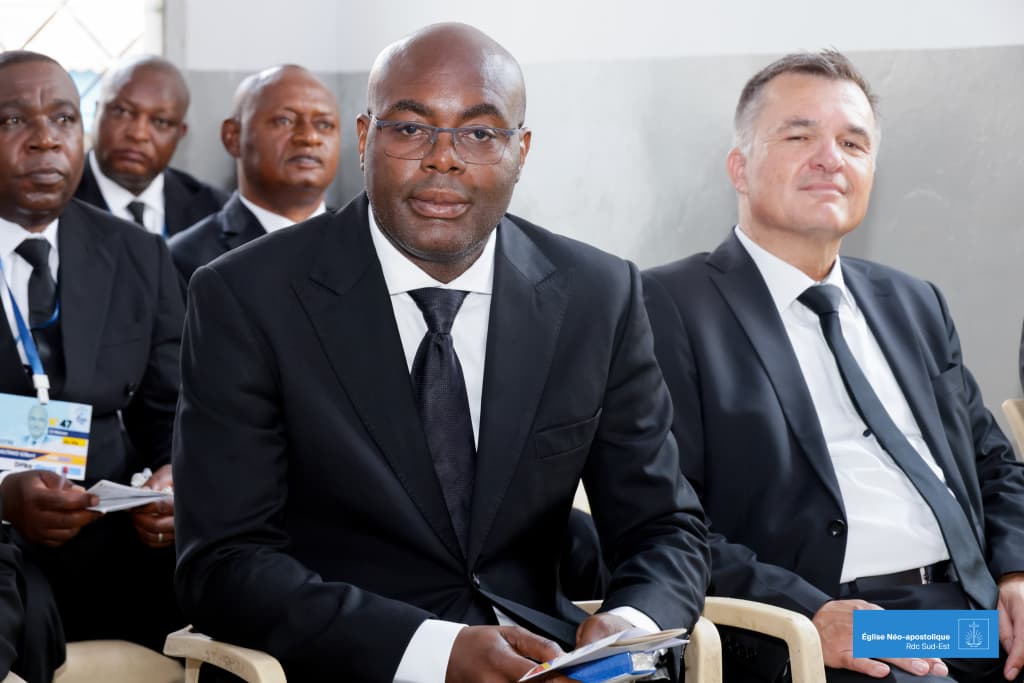
“Don’t be afraid. Just believe!” Our annual motto for 2026 calls on us to trust in God. District Apostle Elie Mukinda from the Democratic Republic Congo-West shows how simple that can be.
Trusting is a choice we make constantly every day. Confidence implies surrendering ourselves to the goodwill, abilities, and credibility of another person. Even in simple daily activities, confidence remains a true resource. Otherwise, life would be extremely stressful.
For instance, no one would board a plane, asking the pilot which university he attended, how many supervised flights he has completed, or even how many unsupervised flights he has flown. No, we simply board the plane with the assurance that we will arrive. That is confidence.
Instinctively, we have learned to trust the weather, the stock market, banks, scientific predictions, and governments. And yet, here and there, it sometimes happens that one or another of these sources is not one hundred per cent reliable because their projections have not materialised as expected. However, our confidence in the expertise of these sources is rarely shaken, and generally, we are even inclined to understand their fallibility.
In contrast, God is infallible in His love, His goodness, His knowledge, and His omnipotence. His promises and His word are always certain and trustworthy. “God is trustworthy” is a fundamental tenet of our faith, subtly woven throughout the Holy Scriptures and our lives.
When we trust Him, we reach the point where we realise we do not have answers to all our questions, but we move forward. We do not necessarily understand or know everything, but we move forward. Because we know the One who has all the answers, and we surrender ourselves to Him. This is confidence, an important dimension of faith.
A nice illustration is of Abraham, the father of faith. Suppose he had been asked sometime after leaving his father’s land, “Where are you going, Abraham?” He would have answered, “I do not know, but I am moving forward because I know the One who knows, and I know that I will arrive.” Similarly, while Abraham was traveling with Isaac to Moriah to offer the sacrifice, Isaac asked him, “Where is the sacrifice?” Abraham’s response was, “God will provide,” meaning: “I don’t know, but I know the One who knows: God. He will provide.”
Ultimately, regardless of external and natural circumstances, those who trust in God experience a life of peace, serenity, and constant joy deriving from this sense of security. Scripture uses several images to illustrate this; they are sometimes compared to a tree planted by the water (Jeremiah 17: 7–8), sometimes to a mountain (Psalm 125: 1). Another striking allegory is that described by Isaiah: “Those who hope in the Lord will renew their strength. They will soar on wings like eagles; they will run and not grow weary; they will walk and not be faint” (Isaiah 40: 31, NIVUK). Confidence in God makes their strength inexhaustible, whether they fly, run, or walk.